























Sim Racing Cockpits and Rigs: 2026 Buying Guide

Updated October 2026
Your sim racing cockpit is the most important purchase decision you will make, more important than your wheel base, your pedals, or your steering wheel. A $1,500 direct drive wheel base bolted to a flexing desk wastes most of its performance. A proper cockpit transfers force feedback directly to your body, eliminates flex, and locks your pedals, seat, and wheel in a consistent position lap after lap.
This guide covers everything you need to know to choose the right sim racing cockpit or rig in 2026, including frame types, driving positions, brand comparisons, and our recommendations for every budget. Apex Sim Racing is an authorized US dealer for Sim-Lab and Sabelt Sim Racing, and every rig we sell ships from the USA.
Types of Sim Racing Rigs
Wheel Stands
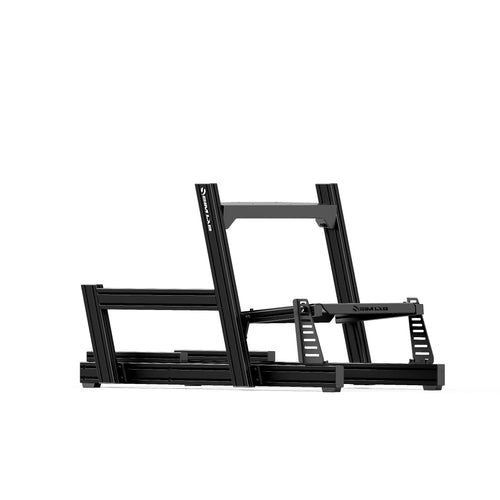
Wheel stands are the entry point: a compact folding frame that holds your wheel and pedals without a seat, designed to pair with your existing office or gaming chair.
The benefits are affordability, a small footprint, and quick setup. Many fold flat for storage, and because there is no seat you slide right up in the chair you already own. Wheel stands handle belt-driven and entry-level direct drive bases up to around 10Nm well. Above that the flex becomes noticeable and starts to diminish force feedback quality, so if you are running a Simagic Alpha EVO or Moza R9 and above, a fixed cockpit will unlock significantly more of what those bases can do.
Best for: tight spaces, tight budgets, and entry-level wheel bases.
Steel Frame Cockpits
Steel frame cockpits use folded or welded steel to build a complete cockpit, with the seat, wheel deck, and pedal plate all in fixed positions. Several brands, including Extreme Sim Racing and Next Level Racing, build cockpits this way.
The benefits are a strong rigidity-to-price ratio and convenience. Steel cockpits often ship as a near-complete station with minimal assembly, and the better ones hold mid-torque direct drive bases without meaningful flex. They are less modular than aluminum profile, so adding accessories or reconfiguring later is more limited, and rigidity varies more between models, so check torque recommendations before you buy.
Best for: a complete, ready-to-race cockpit on a mid-level budget.
Tubular Frame Cockpits
Tubular cockpits are built from round or oval steel tube rather than flat plate or aluminum profile. A well-known example is the Trak Racer TRX, co-developed with the Alpine F1 team.
The benefits of a well-engineered tube frame are serious rigidity and an authentic, race-car-style cockpit feel, often with tool-free switching between formula and GT seating positions. Accessories typically mount with brackets or clamps rather than the slide-in T-slot of aluminum profile, and build quality varies more across this category, so it pays to stick with established brands.
Best for: drivers who want a race-car-style cockpit and quick position changes.
Aluminum Profile Rigs
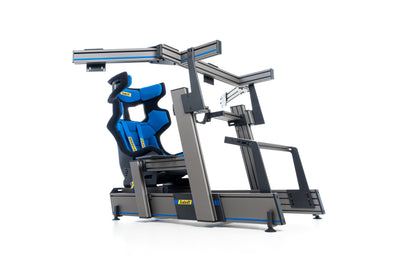
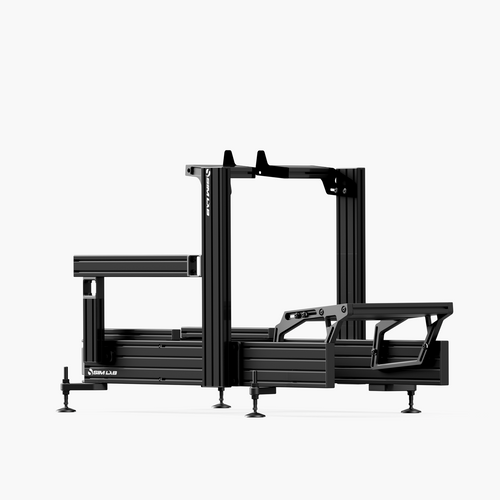
Aluminum profile rigs are built from T-slot aluminum extrusion, the same profile system used in industrial framing. This is the construction used by both brands we carry: Sim-Lab's GT1 and P1X cockpits and Sabelt's full sim racing lineup.


Sim-Lab's aluminum profile range. Left: the GT1 EVO. Right: the P1X Ultimate.
This is the current gold standard for serious sim racers. Rigidity is excellent even with high-torque direct drive bases, and the T-slot design makes the rig fully modular: you can add monitor mounts, button box holders, shifter and handbrake brackets, and other accessories anywhere along the profile with no drilling or welding, then reconfigure the layout as your setup evolves. The trade-offs are a higher price and more assembly time up front.
Best for: high-torque direct drive setups and racers who want to expand and customize over time.
Formula vs GT Position
The two main cockpit driving positions correspond to real motorsport.
GT position puts you upright like a road or GT race car. Your back is relatively straight, arms reach forward to the wheel, pedals are in front. This is the most comfortable position for long sessions and the most versatile across car categories.
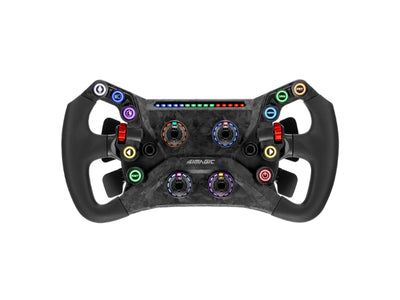
Formula position reclines you like an open-wheel single-seater. You sit lower, legs extended forward toward a high pedal plate, feet almost level with your hips. This replicates the ergonomics of an F1 or Formula car and pairs naturally with a flat-bottom formula steering wheel.
The Sabelt S99 EVO 1 is designed for GT-position racing with wide adjustability, while the P99 EVO 1 is their dedicated formula-position cockpit. Sabelt's X97 and X99 support both positions.
What to Look for in a Sim Racing Cockpit
Frame Rigidity
Rigidity is the most important spec. Any flex in the frame means the force feedback from your wheel base is absorbed by the structure rather than transmitted to your hands. The higher the torque of your wheel base, the more rigidity you need. For bases up to roughly 12Nm, a good steel or tubular frame is sufficient. For 15Nm and above, aluminum profile is the better choice.
Direct Drive Compatibility
Direct drive wheel bases need a front-mount or bottom-mount attachment that can handle high torque loads. Most quality cockpits offer this, but always confirm the mounting option before purchasing. The Sim-Lab P1X Pro is available in a front-mount configuration, the GT1 EVO accepts the Sim-Lab Front Mount EVO, and Sabelt cockpits are built for direct drive wheel bases.
Adjustability
Your cockpit needs to fit your body. Look for adjustable wheel deck height and angle, adjustable seat position, and adjustable pedal plate distance. A cockpit that cannot be dialed in to your ergonomics will be uncomfortable for long sessions regardless of its other qualities.
Modularity and Expandability
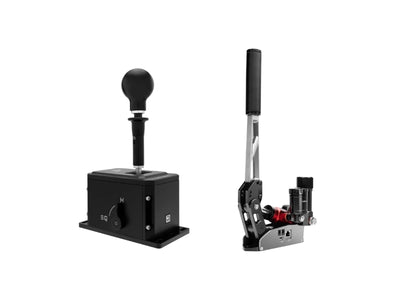
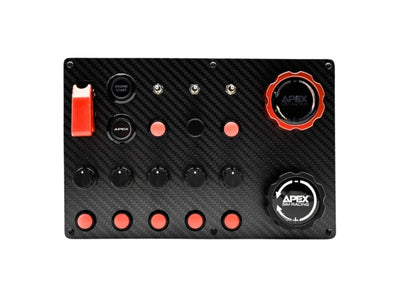
If you plan to add accessories, including a button box holder, monitor mount, shifter or handbrake bracket, or keyboard tray, choose a rig built on a system that supports expansion. Aluminum profile rigs are the best here, since T-slot accessories can be added at any position without modification.
Budget
- Wheel stands: roughly $150 to $350, no seat included
- Entry aluminum cockpits: roughly $450 to $700, such as the Sim-Lab GT1 EVO and GT1 PRO
- Mid range: roughly $750 to $1,000, such as the Sim-Lab P1X Pro and P1X Ultimate and the Sabelt 97 series
- Premium: $1,000 and above, such as the Sabelt 99 and EVO 1 series
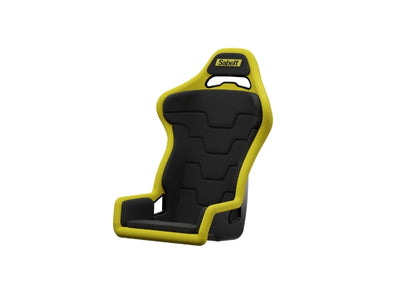
Most aluminum cockpits are sold as a base frame, so budget for a seat as well. Browse Sabelt sim racing seats.
Sim Racing Cockpit Brands in 2026
Sim-Lab Available at Apex
Sim-Lab is a Dutch manufacturer founded in 2015, known for precision-engineered aluminum profile cockpits and a deep ecosystem of accessories. Their range runs from the GT1 EVO, a stiff, modular GT rig that makes an ideal first serious cockpit, through the GT1 PRO, up to the P1X Pro and P1X Ultimate, heavy-duty platforms at the top of their lineup built for high-torque direct drive.

What sets Sim-Lab apart is the ecosystem. Monitor mounts, VESA adapters, shifter and handbrake brackets, button box holders, keyboard trays, and wheel decks are all designed to bolt straight onto their cockpits, so your rig can grow with your setup.
Available at Apex Sim Racing: GT1 EVO, GT1 PRO, P1X Pro, P1X Ultimate, and the Sim-Lab seat and accessory range.
Sabelt Available at Apex
Sabelt is an Italian motorsport company founded in 1972, whose real-world products including harnesses, seats, and safety equipment are used across Formula 1 and international motorsport. Their sim racing lineup brings genuine motorsport engineering to the simulation world. Sabelt sim racing cockpits use 160x40mm base profiles and 120x40mm upright profiles with 10mm CNC-machined aluminum side plates, giving them a noticeably substantial build compared to most competitor frames.


Left: Sabelt S99 EVO 1 GT cockpit. Right: Sabelt P99 EVO 1 formula cockpit.
The S99 EVO 1 is their flagship GT-position cockpit with full adjustability for wheel, seat, and pedal positions. The P99 EVO 1 is their dedicated formula-position cockpit, designed for open-wheel single-seater simulation with a reclined, feet-forward seating position that pairs with the SRP-1 formula seat.
Available at Apex Sim Racing: S97, P97, X97, S99, P99, X99, S99 EVO 1, P99 EVO 1, X99 EVO 1, SIM LITE, and the Sabelt seat and accessory range.
Trak Racer Not at Apex
Trak Racer is an Australian brand founded in 2008. Their range spans aluminum profile rigs from the TR40S through to the TR160 series built on 160x40mm profile, alongside tube-frame designs like the TRX, which was developed in partnership with the Alpine F1 team.
Extreme Sim Racing Not at Apex
Extreme Sim Racing is a Brazilian manufacturer founded in 2008, with a range that runs from wheel stands through steel frame cockpits to aluminum profile rigs.
Advanced Sim Racing Not at Apex
Advanced Sim Racing is a Canadian manufacturer based in Quebec, founded in 2020, and an Official Supplier of sim racing installations for the FIA. They make their own chassis in North America.
Next Level Racing Not at Apex
Next Level Racing is one of the largest sim racing brands by volume, known for accessible cockpits like the foldable F-GT Lite. Their rigs target the entry and mid-range segments.
Our Recommendations at Apex Sim Racing
Sim-Lab GT1 EVO
The GT1 EVO is the most affordable way into a true aluminum profile cockpit. It is stiff enough for most direct drive wheel bases, accepts the Sim-Lab Front Mount EVO for front-mount setups, and works with the full Sim-Lab accessory ecosystem, so it can grow with you as your setup expands.
Shop the GT1 EVO
Sim-Lab GT1 PRO
The GT1 PRO steps up from the GT1 EVO for racers who want a more substantial GT cockpit for long sessions and stronger wheel bases. It keeps the modular Sim-Lab design, so monitor mounts, shifter brackets, and button box holders bolt straight on.
Shop the GT1 PRO
Sim-Lab P1X Ultimate
The P1X Ultimate sits at the top of Sim-Lab's range, a heavy-duty platform built for the strongest direct drive wheel bases and pro-level setups. If you want a more compact step into the P1X platform, the P1X Pro starts at $789.
Shop the P1X Ultimate
Sabelt S99 EVO 1
For sim racers who want competition-grade materials and motorsport heritage, the Sabelt S99 EVO 1 is the standout choice. Built on 160x40mm base and 120x40mm upright aluminum profiles with 10mm CNC-machined side plates and a Zero-X anodized Black Moon finish, it is made in Italy and designed for professional-level setups with high-torque direct drive wheel bases and premium pedal systems.
Shop the S99 EVO 1
Sabelt P99 EVO 1
The P99 EVO 1 is Sabelt's open-wheel formula cockpit, designed to replicate the reclined, feet-forward seating position of an F1 or formula race car. Built on the same 160x40mm and 120x40mm profile architecture as the S99, it pairs naturally with a formula-style steering wheel and elevated pedal mounting for the most authentic open-wheel experience available at Apex.
Shop the P99 EVO 1Frequently Asked Questions
- What is a sim racing cockpit?
- A sim racing cockpit is a dedicated frame or chassis that holds your steering wheel, pedals, seat, and accessories in a fixed, ergonomic position. Unlike a desk or wheel stand, a proper cockpit eliminates flex and movement during force feedback, giving you a more consistent and immersive racing experience.
- What is the difference between a sim racing cockpit and a sim racing rig?
- The terms are used interchangeably. Both refer to a dedicated frame built for sim racing. Cockpit often implies a more enclosed or seat-integrated setup, while rig typically refers to an open aluminum profile frame. In practice there is no strict distinction.
- What sim racing cockpit is best for direct drive wheel bases?
- Direct drive wheel bases from Simagic, Moza Racing, and Simucube generate high torque, from 9Nm up to 28Nm, so they need a rigid aluminum profile rig with a proper front or bottom mount. The Sim-Lab GT1 EVO and GT1 PRO handle most direct drive setups, while the Sim-Lab P1X and Sabelt's cockpit lineup are built for the highest-torque bases.
- What is the difference between a GT and formula sim racing cockpit?
- A GT cockpit positions you upright like a road or GT race car. A formula cockpit reclines you further back to replicate the low, feet-forward seating of an open-wheel race car. Some rigs, like the Sabelt X97 and X99, support both positions.
- How much does a sim racing cockpit cost?
- At Apex Sim Racing, aluminum profile cockpits start at $449 with the Sim-Lab GT1 EVO. Mid-range rigs like the Sim-Lab P1X Pro and the Sabelt 97 series run roughly $750 to $950, and premium cockpits like the Sabelt 99 and EVO 1 series range from about $1,000 to $1,300+. Most are sold as a base frame, so budget for a seat as well.
- Do I need a cockpit for sim racing?
- You do not need one to get started, but once you move to a direct drive wheel base or load cell pedals, a proper cockpit makes a significant difference. A rigid frame prevents flex that distorts force feedback, improves pedal feel consistency, and lets you build the exact ergonomic setup you need.
All brand names and trademarks are the property of their respective owners. Apex Sim Racing is not affiliated with Trak Racer, Extreme Sim Racing, Advanced Sim Racing, or Next Level Racing. Prices and specifications are accurate as of October 2026 and are subject to change; always confirm current details on the product page.

 https://www.apexsimracing.com


Leave a comment